
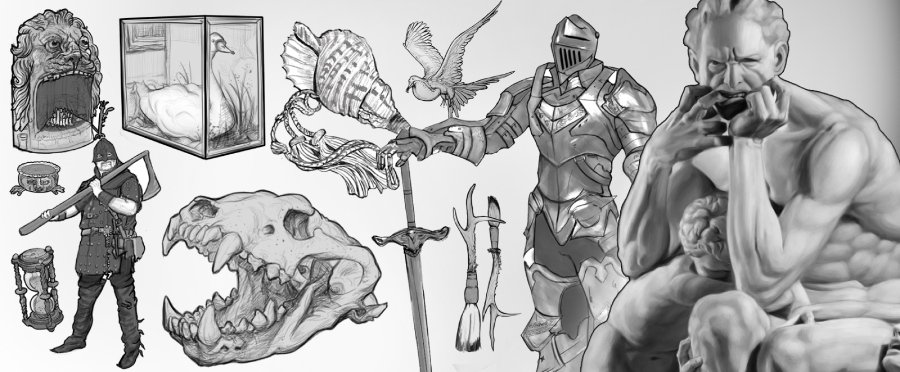
Why Is Learning 3D Modelling More Valuable Than Ever in 2026
Today, 3D modelling skills are in high demand across a range of professional fields, including animation studios and game development. It has become one of the most powerful creative skills that affects the digital world today. Virtual reality, interactive media, product visualization, blockbuster films, and video games are but a few of the many areas where 3D assets are driving the experiences people encounter in their everyday lives.
With industries moving towards immersive content and a real-time digital world, the skills to learn 3D modelling and translate ideas into detailed digital objects have become more useful. As of 2026, this ability will be at the intersection of art, technology, and storytelling, making it one of the most applicable skills for future creators.
The Bigger Digital Asset Economy.
The development of the digital asset economy is one of the most obvious indicators behind the increase in the value of 3D modelling. Industry research has pegged the global 3D digital asset market at about 32.47 billion in 2025, and this is estimated to grow to about 36.72 billion in 2026. This growth indicates a colossal need for digital models applied in games, motion pictures, e-commerce visualization, architecture, and immersive media.
Simultaneously, there is an availability of 3D creation tools more than ever. In 2024, the open-source platform Blender had almost 21 million downloads, indicating that millions of creators are experimenting with 3D modelling workflows.
All these trends combined demonstrate that 3D creation is no longer the domain of professional studios. It has now become an international creative skill.
Entertainment Is Built on Three-Dimensional Worlds.
There is no business sector in which the influence of 3D modelling could be disregarded, but entertainment is one of them. All digital characters, environments, vehicles, and objects seen in contemporary games or movies start as meticulously designed 3D models.
The importance of visual design can be depicted by the recent success of creativity. The indie game Neva won Artistic Achievement at the 2025 BAFTA Awards Games, and Astro Bot won Game Design, underscoring the importance of strong visual language and interactive spaces in creating player experiences.
The same is true of film production. Dune: Part Two was also the 2025 Academy Award winner in the Best Visual Effects, demonstrating the awe-inspiring work of digital modelling and simulation in realising the movie worlds.
These instances point to a broader fact: the audiences of the world today are frequently pitted against one another by convoluted pipelines for modelling, texturing, and rendering.
Immersive Industries on the Rise
In addition to entertainment, 3D modelling has also emerged as an important tool in a number of fast-expanding industries.
Product visualization in three dimensions is becoming increasingly popular among brands as an element of designing digital showrooms where customers can interact with products before making purchases. Architects and designers have gone on to create interactive digital spaces where clients can walk around buildings even before construction begins.
Other sectors are also adopting the use of 3D modelling:
- AR and VR experience.
- Simulations, medical, and training.
- film and advertising Virtual production.
- manufacturing and city planning digital twins.
With these technologies constantly evolving, developers of more detailed digital objects and spaces are becoming vital to numerous creative and technical teams.
Thinking in Three Dimensions
For beginners, acquiring knowledge of 3D modelling may start with mastering software. But connoisseurs of art are aware that there is another much greater difficulty--acquisition of the faculty of thinking three-dimensionally.
Modeling involves learning to handle shapes, surfaces, and proportions in the digital space. Artists need to take into account how light interacts with materials, how topology interacts with animation, and how assets interact with real-time engines.
This is the reason why the concept of 3D modelling tends to intersect artistic and technical thought. The concepts that artists are working with are:
- Mechanical objects and environments are modelled with hard-surface modelling.
- organic modelling on characters and creatures.
- topology and mesh structure, which affect animation and deformation.
- texturing and materials, which provide objects with visual realism.
- Lighting and rendering define the final perception of the scenes.
The ability to master these aspects enables creators to build believable digital worlds from simple geometric shapes.
Where 3D Modelling Intersects Game Development
One of the most obvious uses of 3D modelling is still game development. All props, surroundings, and characters that a player encounters have been developed and optimized for real-time engines like Unity or Unreal Engine.
Games that boast of the visual direction they put in show how much thought goes into them. Titles such as Metroid: Fusion, which was noted for its best art direction, demonstrate how stylized environments and characters shape the identity of a whole game.
Behind these spaces are artists who constantly construct and refine digital properties to make them look impressive and efficient.
Although tutorials may indicate the location of the buttons, to learn how to 3D model correctly, one must simply know how real-world professionals construct assets used in real production pipelines, such as topology and texturing, as well as how to make the model work with any particular real-time engine, such as Unreal or Unity. Systemic learning environments enable creators to transition to more portfolio-ready work and work more quickly than experimentation towards what studios actually seek.
Creative Opportunities in All Industries
Due to the growing digital world, individuals with 3D modelling skills are finding opportunities in many areas that require creativity.
The most popular career opportunities are:
- 3D artist, game, film, and simulation art.
- environment artist, landscapes and digital worlds designer.
- character artist, priest of characters and monsters.
- technical artist, between art and real-time engines.
- product visualization designer, developing models of marketing and design teams.
The U.S. Bureau of Labor Statistics says that employment opportunities in fields associated with multimedia art and animation continue to rise annually as the digital media sector expands.
Nowadays, as a potential creator, 3D modelling provides a broad horizon of creative and technical possibilities.
The Future of Digital Creation
As one looks to the future, it is likely that the role of 3D modelling will be even greater. The world of digital worlds is being transformed by real-time rendering systems, immersive virtual worlds, and AI-assisted creative tools.
As these technologies mature, artists who have learned the rudiments of designing objects and spaces in 3D will remain vital in shaping what digital media will become.
By 2026, the process of learning 3D modelling cannot be in software usage only, but as a creative technical skill to create a visual language of the digital world.
And to those who want to shape the world, people, and lives audiences engage with daily, that ability has never been more desirable.





0 Comments